Legal Strategy
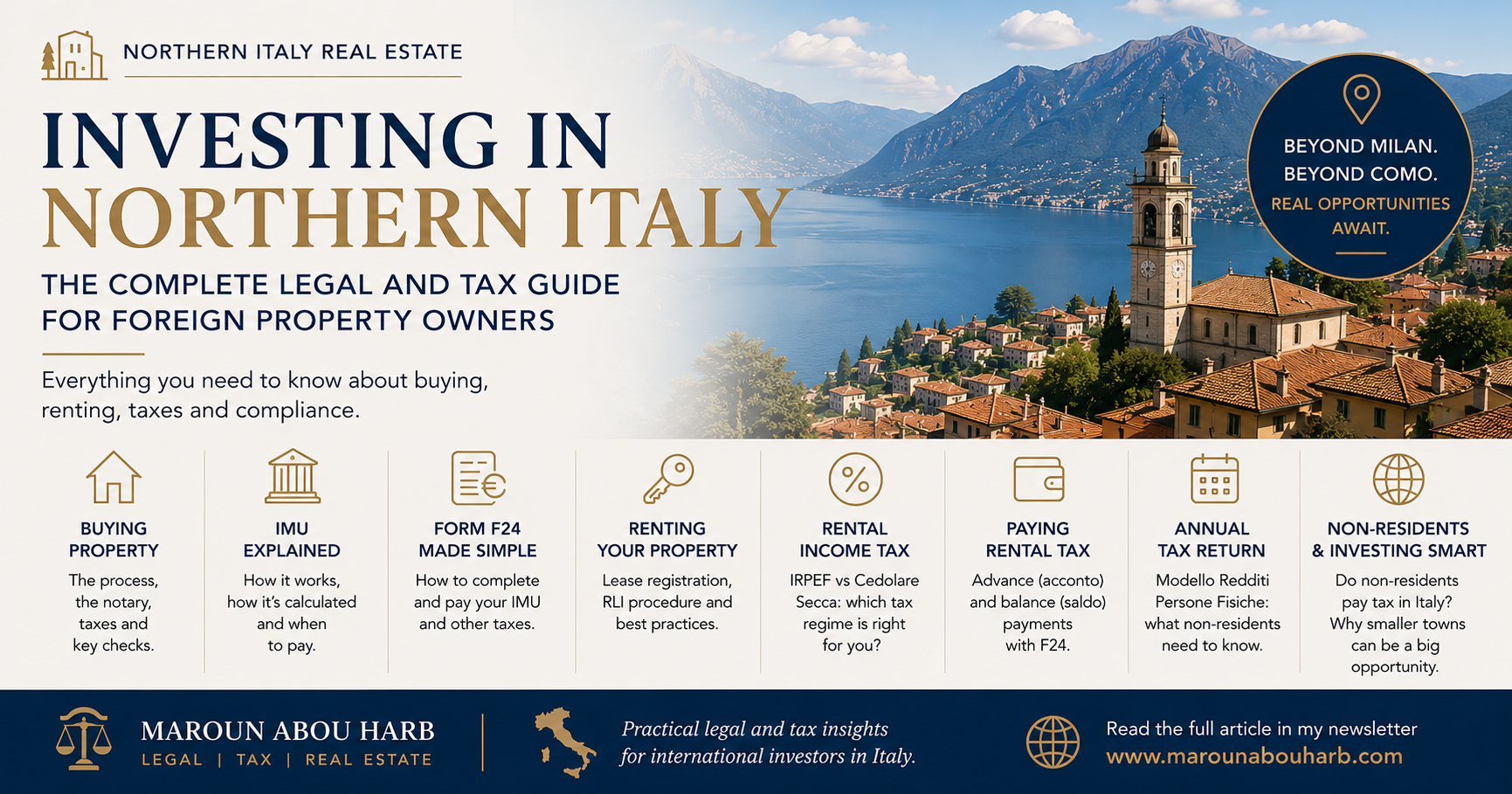
Buying and Renting Property in Northern Italy: A Practical Guide for Foreign Investors
28 June 2026
Northern Italy has become increasingly attractive for international investors looking for affordable real estate with strong rental potential. Areas surrounding Lake Como, including smaller municipalities such as Lanzo d’Intelvi, offer an opportunity to acquire properties at prices that are difficult to find elsewhere in Western Europe while benefiting from tourism, cross-border demand from Switzerland, and long-term capital appreciation.
However, purchasing the property is only the first step. Every investor should understand the ongoing tax obligations and the process of renting the property legally.
1. Buying the Property
Buying a property in Italy is a formal process that is usually completed before an Italian notary. The notary plays a central role in the transaction. He or she verifies the identity and capacity of the parties, checks the title, confirms the cadastral details of the property, calculates the taxes due on the purchase, and registers the deed of sale with the competent public registries.
Once the deed of sale is signed, the purchaser becomes the legal owner of the property. From that moment, the owner is responsible not only for the property itself, but also for the administrative, tax and maintenance obligations attached to it. This is particularly important for foreign buyers, because owning property in Italy creates certain Italian tax obligations even if the owner does not live in Italy.
Each property is identified through cadastral records. These records include the municipality where the property is located, the cadastral category, the cadastral class, the number of rooms or surface area, and the rendita catastale, which is the official cadastral income attributed to the property. These details are not merely technical information. They are used by the Italian authorities to identify the property and to calculate certain taxes.
The rendita catastale is especially important. It does not usually correspond to the real market value or rental value of the property. Instead, it is an official tax value assigned to the property. This amount is used as the starting point for calculating taxes such as IMU, which is the annual municipal property tax generally due on second homes and investment properties.
For investors, it is therefore important to review the cadastral information before completing the purchase. Two properties with the same market price may have different cadastral values and therefore different annual tax costs. Understanding this information early allows the buyer to estimate the future holding costs of the property more accurately.
After the purchase, the owner should keep copies of the deed of sale, cadastral documents, tax payment receipts, condominium documents, and any correspondence with the municipality or tax authorities. These documents will be useful when paying IMU, registering a lease, filing taxes, selling the property in the future, or dealing with any administrative issue relating to the property.
2. IMU: The Annual Municipal Property Tax
After purchasing a property in Italy, one of the main recurring obligations to consider is IMU, which stands for Imposta Municipale Unica. IMU is the annual municipal property tax due on most properties that are not used as the owner’s principal residence in Italy. For foreign investors, holiday-home owners, and non-resident landlords, the property will usually be treated as a second home or investment property, meaning that IMU will generally be payable.
IMU is not calculated on the purchase price or on the current market value of the property. This is an important point for foreign investors to understand. Instead, the tax is calculated by reference to the property’s cadastral value, which is derived from the rendita catastale recorded in the Italian cadastral register. The rendita catastale is usually much lower than the actual market value of the property, but it remains the key figure used for IMU purposes.
The calculation usually starts with the rendita catastale, which is revalued and then multiplied by a statutory coefficient depending on the cadastral category of the property. The applicable IMU rate is then applied to that value. Each Comune, or municipality, sets its own IMU rate within the limits permitted by Italian law. As a result, two similar properties in different municipalities may have different annual IMU costs.
For this reason, investors should not only look at the purchase price when assessing a property. They should also check the rendita catastale, the cadastral category, and the IMU rate applied by the relevant municipality. This is particularly useful when comparing properties in areas such as Lake Como, Lanzo d’Intelvi, Porlezza, Menaggio, or other northern Italian towns where property prices and local tax rates may vary significantly.
IMU is generally paid in two instalments each year. The first instalment is the acconto, or advance payment, which is normally due by 16 June. The second instalment is the saldo, or final balance, which is normally due by 16 December. The June payment is generally calculated as an advance, while the December payment adjusts the amount due for the year based on the final rates and rules approved by the municipality.
Owners should diarize these dates carefully. Italian tax authorities do not usually send foreign owners a reminder or invoice for IMU. The obligation to calculate and pay the tax remains with the taxpayer. Missing the deadline can result in penalties and interest, although voluntary late payment procedures may sometimes reduce the penalty if the taxpayer regularizes the position promptly.
3. Paying IMU Using Form F24
IMU is usually paid using the Modello F24, which is the standard Italian tax payment form used for many types of taxes. The F24 form allows the taxpayer to identify the tax being paid, the relevant municipality, the tax year, the type of payment, and the amount due.
For IMU, the relevant part of the form is the municipal taxes section. In that section, the taxpayer must usually indicate the Comune code, which identifies the municipality where the property is located. For example, each municipality has its own specific code, and using the wrong code may result in the payment being allocated incorrectly.
The taxpayer must also indicate the correct codice tributo, which identifies the type of IMU payment being made. The tax code differs depending on the type of property and the nature of the payment. For most ordinary second homes and investment residential properties, the relevant IMU code will generally relate to “other buildings,” but the exact code should always be checked before payment.
The form also requires the tax year, the number of properties, and the amount being paid. It is also important to indicate whether the payment is an acconto or a saldo. This distinction matters because the June payment and the December payment serve different purposes in the annual IMU cycle.
Foreign owners who have an Italian bank account may often be able to pay the F24 through online banking. Some banks provide a specific section for F24 payments. Alternatively, the payment can be made through an authorised tax intermediary, accountant, or certain payment service providers. For non-resident owners, using an Italian accountant or tax adviser can be helpful, especially in the first year, to ensure that the correct municipality code, tax code, and amount are used.
After payment, the owner should keep a copy of the completed F24 form and the payment receipt. These documents are important evidence that the tax was paid. They may be needed in the future when selling the property, responding to a municipality request, regularising a tax position, or preparing the annual tax return.
In practice, IMU compliance is not complicated once the system is understood. The key is to know the property’s cadastral data, verify the applicable municipal rate, calculate the amount correctly, pay it through the F24 form by the June and December deadlines, and retain proof of payment.
4. Renting the Property
Once the property is ready to be rented, the first step is to prepare a written lease agreement. In Italy, residential leases should not be treated casually, especially where the landlord is a foreign owner. A clear written agreement helps define the rent, duration, payment terms, deposit, utilities, condominium expenses, maintenance obligations, and rules for termination.
The lease agreement should generally be registered with the Agenzia delle Entrate, which is the Italian Revenue Agency. Registration is not merely an administrative formality. It gives the lease legal certainty, makes the relationship transparent from a tax perspective, and allows the landlord to report the rental income correctly.
Lease registration is commonly completed through the RLI procedure. This can usually be done electronically, either directly by the taxpayer if he or she has access to the Agenzia delle Entrate online services, or through an authorized intermediary such as an accountant, tax adviser, real estate agent, or other professional.
For foreign owners who do not have SPID, CIE, CNS, or direct online access to the Italian tax portal, using a local intermediary is often the most practical solution. The intermediary can assist with the registration, confirm the correct tax regime, and help ensure that the lease is properly reflected in the tax system.
A properly registered lease is also important because it may allow the landlord to opt for the Cedolare Secca regime, where eligible. This option can be highly beneficial for private landlords renting residential properties, as it replaces the ordinary income tax treatment with a flat tax regime.
5. Rental Income Tax
Rental income from Italian real estate is taxable in Italy, even if the owner is not resident in Italy. This means that a foreign owner who rents out an apartment in Italy must consider Italian tax obligations even if he or she lives abroad and has no other Italian income.
In general, rental income can be taxed under either the ordinary IRPEF regime or, where the conditions are met, under the Cedolare Secca regime. The correct choice depends on the type of lease, the profile of the landlord and tenant, and the overall tax position of the owner.
For many private residential landlords, however, Cedolare Secca is often the preferred option. Cedolare Secca is a substitute tax regime that applies a flat tax to qualifying residential rental income. For most ordinary residential leases, the rate is 21%. In certain specific cases, such as qualifying agreed-rent contracts in eligible municipalities, a reduced rate may apply, but this depends on the type of contract and local rules.
The main advantage of Cedolare Secca is simplicity. Instead of subjecting the rental income to progressive IRPEF rates and related surtaxes, the landlord pays a flat substitute tax. In addition, when Cedolare Secca applies, the landlord generally does not pay registration tax or stamp duty on the lease.
There is, however, an important trade-off. By choosing Cedolare Secca, the landlord generally waives the right to increase the rent during the period in which the regime applies, including increases based on inflation indexation. This should be considered carefully, especially for longer leases.
For foreign investors owning one or two residential apartments in Italy, Cedolare Secca can be considerably simpler and more predictable than the ordinary regime. It allows the investor to estimate the tax cost more easily and may reduce the administrative burden connected with rental income.
6. Paying Rental Tax
Rental tax in Italy is generally not automatically withheld from ordinary residential rent payments. This means that the landlord is responsible for declaring the rental income and paying the relevant tax.
The payment is usually made through the Modello F24, which is the same general tax payment form used for many Italian taxes. Depending on the taxpayer’s position, payments may include an acconto, meaning an advance payment, and a saldo, meaning the final balance.
The saldo settles the tax due for the previous tax year, while the acconto is an advance payment toward the current tax year. The amount of the advance payment is generally calculated by reference to the tax due for the previous year. This can create confusion for first-time landlords, because the first year of rental activity may not always involve the same payment pattern as later years.
For example, if a property is first rented during the year, the tax return filed the following year will calculate the tax due on that first rental income. Depending on the amount, the taxpayer may also become required to pay an advance toward the following year. This is why many landlords see both a balance payment and an advance payment appearing in the same tax cycle.
Foreign landlords should be particularly careful with these deadlines because the Agenzia delle Entrate will not necessarily send a simple invoice or reminder. The obligation to calculate, declare, and pay the tax remains with the taxpayer.
In practice, the safest approach is to keep a clear record of all rent received, the registered lease, F24 payment receipts, deductible or relevant expenses where applicable, and correspondence with any accountant or intermediary. These records will help when preparing the annual Italian tax return and when proving that the rental income was properly declared and taxed.
7. Filing the Annual Tax Return
Owning and renting out a property in Italy generally requires the landlord to file an annual Italian income tax return. This applies even where the landlord is not resident in Italy and even where the rental income is the only Italian-source income received during the year.
For most non-resident individual owners, the relevant return is the Modello Redditi Persone Fisiche. This return is used to report the Italian rental income, the applicable tax regime, the taxes already paid through F24, and any further tax due or refundable.
This is an important point for foreign owners to understand. Paying tax through F24 does not automatically replace the filing obligation. The F24 is the payment mechanism, while the annual tax return is the document through which the income is formally declared and the tax position is reconciled.
The tax return also allows the taxpayer to show whether the rental income is taxed under the ordinary IRPEF regime or under Cedolare Secca. It records the rental income received during the relevant tax year and calculates the balance and advance payments due, if applicable.
For non-resident landlords, using an Italian accountant or authorized tax intermediary is often the most practical approach, especially in the first year. This helps ensure that the income is reported correctly, that the correct tax regime is applied, and that the payments made through F24 are properly matched with the annual return.
8. Do Non-Residents Pay Tax in Italy?
Yes. A non-resident owner can be taxable in Italy if the income arises from Italian real estate. This means that if a foreign investor owns an apartment in Italy and rents it out, the rental income is generally considered Italian-source income and must be declared in Italy.
However, this does not mean that the non-resident owner is automatically taxed in Italy on worldwide income. In general, non-residents are taxed in Italy only on income arising in Italy. Therefore, a foreign landlord with no Italian tax residence and no other Italian income will usually be concerned only with the Italian property income and related obligations.
The position may also be affected by a double taxation treaty between Italy and the owner’s country of tax residence. These treaties are designed to prevent the same income from being taxed twice in an unfair manner. In many cases, Italy will retain the right to tax income from real estate located in Italy, while the country of residence may grant relief, credit, or exemption depending on its own domestic rules and the applicable treaty.
Foreign investors should therefore consider both sides of the equation. It is not enough to ask whether tax is due in Italy. The investor should also check whether the rental income must be reported in the country where he or she is tax resident, and whether any foreign tax credit or treaty relief is available there.
9. Is Investing in Smaller Northern Italian Towns Worth It?
Many foreign investors immediately think of Milan, central Como, or the most famous towns around Lake Como. These locations are attractive, but they are also significantly more expensive. Smaller northern Italian towns, including municipalities around the Intelvi Valley (Lanzo d’Intelvi), Porlezza, Menaggio, and other areas near Lake Como, can offer a different type of opportunity.
The main advantage is entry price. In some smaller towns, it is still possible to find apartments at prices that are much lower than those in major cities or prime lakefront locations. This lower entry cost can improve the rental yield, especially if the property is purchased well, renovated intelligently, and marketed to the right type of tenant.
These areas may also benefit from their proximity to Switzerland, seasonal tourism, weekend visitors, remote workers, and people looking for affordable accommodation near the Lake Como region. For a foreign investor, this can create a useful combination of personal use and rental potential.
However, lower purchase prices should not be the only factor. Investors should carefully assess annual condominium expenses, renovation costs, IMU, local rental demand, property management costs, vacancy risk, and long-term demographic trends. A cheap property is not automatically a good investment if it is difficult to rent, expensive to maintain, or located in a building with unresolved issues.
In smaller towns, the best investments are usually not the cheapest properties in absolute terms, but the properties that offer the right balance between price, condition, location, rental demand, and future usability. A well-located apartment with reasonable expenses and strong rental appeal can produce attractive cash flow while still offering the possibility of long-term capital appreciation.
Final Thoughts
Italian real estate remains one of Europe’s most accessible investment markets. The law is well established, property rights are strong, and foreign buyers can acquire and own property with a high degree of legal certainty.
The tax system may appear complex at first, especially for non-residents unfamiliar with IMU, F24 forms, lease registration, Cedolare Secca, and annual tax returns. However, once the process is understood, the obligations become manageable and relatively predictable.
For investors willing to approach the market carefully, purchasing and renting residential property in Northern Italy can represent a compelling long-term investment. It can combine recurring rental income, personal use, exposure to a desirable European region, and the possibility of capital appreciation over time.
Need advice on a live matter?
Submit a confidential inquiry and briefly describe the situation.
Book Consultation